The Context Chronicle, Episode 04: Anthropic and the Architecture of Memory
Between February and May 2026, Anthropic shipped a release every two weeks. Not one was about a smarter model. Every single one was about context.
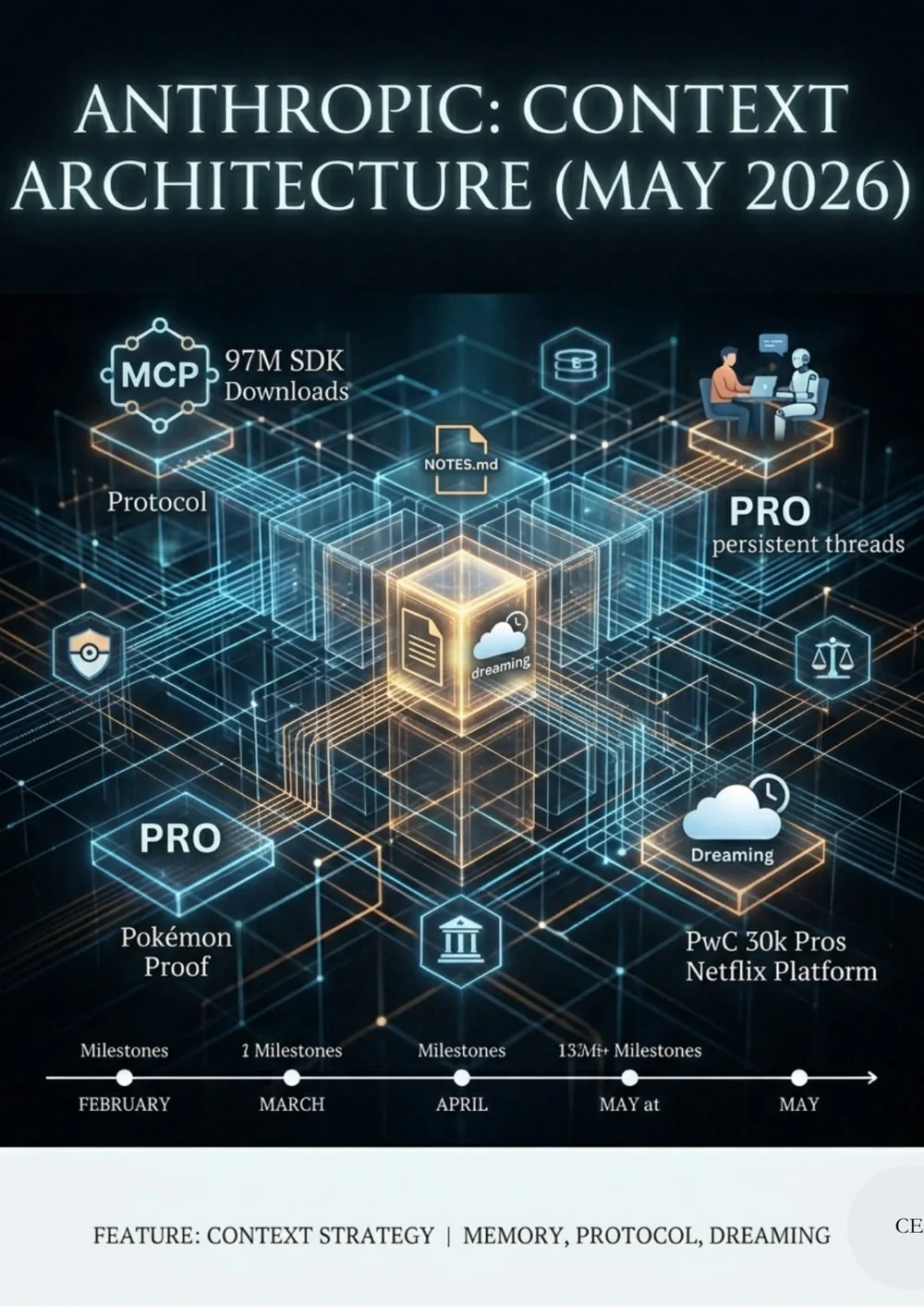
A series on how the world's leading AI labs are converging on the same conclusion.
Between February 1 and mid-May 2026, Anthropic executed a relentless product offensive, shipping a major release roughly every two weeks. Twenty-four significant product updates and ecosystem milestones in just over 100 days.
Not one of those releases was about making the model "smarter" in the conventional sense. Every single one was about context.
What most observers tracked as an aggressive corporate changelog was, in reality, a masterclass in strategic architecture, assembled one piece at a time, in public, at a pace the AI industry had never seen from the lab.
Each release was an interdependent building block:
- Persistent Agent Workflows and Threads, to ensure that complex tasks can span multiple days and sessions without losing their place.
- The Cowork Marketplace and Legal Connectors, to extend context reach across third-party systems and deeply siloed vertical knowledge bases.
- The open-source Model Context Protocol (MCP), which smashed the data silos that trap models behind enterprise walls.
- Structured Memory and Multiagent Orchestration, allowing fleets of specialized agents to share state and continuously update their knowledge base.
- Agentic "Dreaming", which teaches autonomous systems to review, curate, and optimize their own experiences while offline.
What Anthropic built during this window is not a disparate collection of features. It is a philosophy of intelligence made executable. The philosophy states that context is not infinite storage; it is a precision instrument. The agent that wins is not the one that remembers everything. It is the one that knows what to remember, when to recall it, and what to safely release.
A little bit of history
In September 2025, Anthropic's engineering team published a foundational piece titled Effective Context Engineering for AI Agents. It remains the most honest diagnosis of where enterprise AI actually fails.
The core argument was simple: most agent failures are not model failures. They are context failures.
Long-horizon tasks require agents to maintain coherence and goal-directed behavior over sequences of actions where token counts vastly exceed the context window. Even as context windows scale to millions of tokens, they remain highly vulnerable to context pollution, the phenomenon where flooding a model with indiscriminate data degrades its processing sharpness.
This insight separates context engineering from context scaling. While competitors wagered their futures on raw scale, giving models more raw data, more tokens, and more unfiltered sources, Anthropic bet on precision. Their architecture aims to give a model exactly what it needs, exactly when it needs it, with everything irrelevant ruthlessly cleared away.
The engineering team practicalized this philosophy through three core techniques:
- Context compaction. When agents reach context limits, the system summarizes conversation history into a condensed form and continues, allowing work to span extended time horizons without losing coherence.
- Tool-result clearing. Once a tool has been successfully executed deep in message history, the raw output is cleared from active memory, keeping the context window clean without sacrificing capability.
- Structured note-taking (agentic memory). The agent regularly writes progress notes persisted to memory outside the context window. Like Claude Code maintaining a local
NOTES.mdfile, this simple pattern lets the agent track progress across complex tasks, reading its own notes after context resets to continue multi-hour sequences as if nothing interrupted it.
The Pokémon proof
To prove this wasn't just a coding trick, Anthropic demonstrated it in non-coding domains by letting Claude play Pokémon. The agent maintained precise tallies across thousands of game steps, tracking objectives like: "For the last 1,234 steps I've been training my Pokémon in Route 1; Pikachu has gained 8 levels toward the target of 10." Without explicit prompting, it developed maps of explored regions, remembered unlocked milestones, and maintained strategic combat notes.
The game was a proof of concept for long-horizon coherence. Memory is what converts a capable model into a reliable agent.
MCP wins the plumbing
In November 2024, Anthropic published the Model Context Protocol. Within sixteen months, it became the fastest-adopted infrastructure standard in AI history.
By March 2026, MCP reached an astronomical 97 million monthly SDK downloads, an adoption curve that Kubernetes took nearly four years to achieve. Three factors drove this explosion:
- Anthropic open-sourced MCP under the MIT license with zero fees and no vendor lock-in.
- The protocol itself is elegant, using JSON-RPC over standard transports.
- Anthropic seeded the ecosystem early with robust reference implementations for GitHub, Slack, Postgres, and Google Drive.
Today, there are more than 10,000 active public MCP servers. The protocol has been natively adopted by ChatGPT, Cursor, Gemini, Microsoft Copilot, and Visual Studio Code, backed by enterprise deployment infrastructure from AWS, Cloudflare, Google Cloud, and Azure.
The standards war is effectively over. Every major AI lab ships MCP-compatible tooling. Anthropic did not just win a benchmark. It won the protocol.
MCP eliminated the N×M integration nightmare by providing a universal standard for connecting AI systems to data sources. By donating the protocol to the Linux Foundation, Anthropic took it off the table as a competitive weapon and turned it into a public good. The goal was never to own the enterprise plumbing, but to make the context layer universally accessible, so that Claude can operate seamlessly in every existing enterprise architecture.
Moving to enterprise deployment
On April 23, 2026, Anthropic made memory for Claude Managed Agents available in public beta, storing memories as structured files on a filesystem. For the first time, developers could export, edit, and manage agent memories via API or directly within the Claude Console.
The early enterprise results redefined productivity metrics:
- Rakuten deployed long-running task agents that used memory to avoid repeating past mistakes, reporting 97% fewer first-pass errors within workspace boundaries, alongside a 27% reduction in costs and a 34% improvement in latency.
- Netflix integrated memory to carry context across complex developer sessions, preserving insights that took multiple turns to uncover, alongside mid-conversation corrections from human reviewers.
- Wisedocs built its document verification pipeline on Managed Agents, leveraging cross-session memory to instantly identify recurring document issues.
A 97% reduction in first-pass errors did not come from a heavier model or a breakthrough in raw compute. It came from an elegant memory architecture.
Instead of treating context as a volatile per-session sandbox, agents store data and reuse it systematically. According to Anthropic, agents can now self-learn across sessions and share that learning with each other. They teach one another not through centralized, compute-heavy fine-tuning, but through structured memory files that one agent writes and another reads. The intelligence is no longer trapped in static model weights. It lives in the accumulated, curated, and transferable context.
Then came Dreaming
Then came May 6, 2026, and Anthropic introduced a production feature that shook the philosophy of agentic autonomy: Dreaming.
Sounds metaphoric, right? It is a scheduled, production-grade background process shipping directly to enterprise customers.
[Active Working Session] ──> (Logs Session History) ──> [Offline "Dreaming" State]
                                                                  │
[Optimized Context Layer] <── (Curates & Consolidates Memory) ◄───┘
Dreaming runs when the agent is offline. It systematically reviews past sessions, extracts behavioral patterns, handles selective memory consolidation, and updates its memory files. Developers retain full guardrail control: dreaming can update memory autonomously, or stage changes for human review before landing.
Most legacy AI memory systems merely accumulate tokens indiscriminately. As history grows, the computational cost rises and the relevance of older memories decays, making the model slower and noisier.
Dreaming introduces a structured mechanism for memory decay and reinforcement. The agent evaluates its own experiences, deciding what to cement, what to update, and what to safely forget. It improves from the inside out, not because its foundational weights changed, but because the context layer it inhabits has become more precise.
Concurrently, multiagent orchestration and validation
Simultaneously, Anthropic launched Multiagent Orchestration, allowing a lead agent to break complex enterprise jobs into distinct pieces and delegate them to a fleet of specialized sub-agents, each equipped with its own tailored model, prompt, and toolset.
The breakthrough was achieved through an architectural detail: a shared filesystem. Sub-agents do not operate in isolated silos, merely returning a final answer without the underlying reasoning. Instead, they work in parallel on a shared filesystem, contributing to a persistent, collective memory that every agent in the fleet can read, write to, and build upon. Context flows between agents not as ephemeral message passing, but as shared organizational state.
The market validation
The commercial validation of this architecture arrived at an unprecedented scale.
PwC announced a massive global rollout of Claude Code and Cowork, establishing a joint Center of Excellence to train and certify 30,000 professionals. In practice, insurance underwriting tasks that previously took 10 weeks were compressed to 10 days, an 86% drop in time cost that fundamentally alters the economics of which deals are viable to pursue. Most notably, PwC launched a new standalone business group, the Office of the CFO, anchored entirely on Claude's context architecture.
Enterprise alliances. Mega-alliances with Blackstone, Hellman & Friedman, and Goldman Sachs saw the creation of a new enterprise AI services company, alongside expanded infrastructure partnerships making the Claude platform generally available on AWS.
Cognitive resources. Accompanying Claude Opus 4.7 (whose native planning capabilities let it catch its own logical faults, lifting benchmark performance by 13%), Anthropic introduced Task Budgets. Developers can now guide Claude's token spend over massive runs, allowing the model to self-allocate its attention, engineering its own cognitive resources around what to process deeply versus what to scan quickly.
Conclusion
Anthropic has moved decisively beyond the chatbot into creative tools, autonomous code workflows, and production-grade security systems. Over the last 100 days, it has become obvious how binding a constraint the context layer can be.
This is the thesis we have argued from the start: the frontier is no longer the model, it is the context around it. The labs are converging on the same conclusion that drives everything we build at Context Engine. The intelligence that matters does not live in the weights. It lives in the accumulated, curated, transferable context, the institutional memory, the live signals, and the synthesis between them.
So how do we build and refine intelligence?
The Context Chronicle continues. Up next: do we speak on convergence among the labs in the West, or head over to the East?
Context Engine builds the contextual layer for global enterprises. Explore the platform or talk to us.
Further reading
- Anthropic, Effective Context Engineering for AI Agents. The foundational essay behind this architecture.
- Model Context Protocol. The open standard, now adopted across every major lab.
- Anthropic, Introducing the Model Context Protocol. The original launch announcement.
- Claude Code. The agentic coding tool where the
NOTES.mdmemory pattern originated. - Context Engine, Beyond the Data Cloud: Why Context Is the Real Bottleneck. Our earlier commentary on the same shift at Google Cloud.
Talk to us
Ready for intelligence that acts?
Stop reacting to information. Start operating with context. See how ContentHub turns documents into institutional memory and PulseMI tracks the signals that matter.